Will AI Take Your Job in India? 2026 Guide (Non-IT)
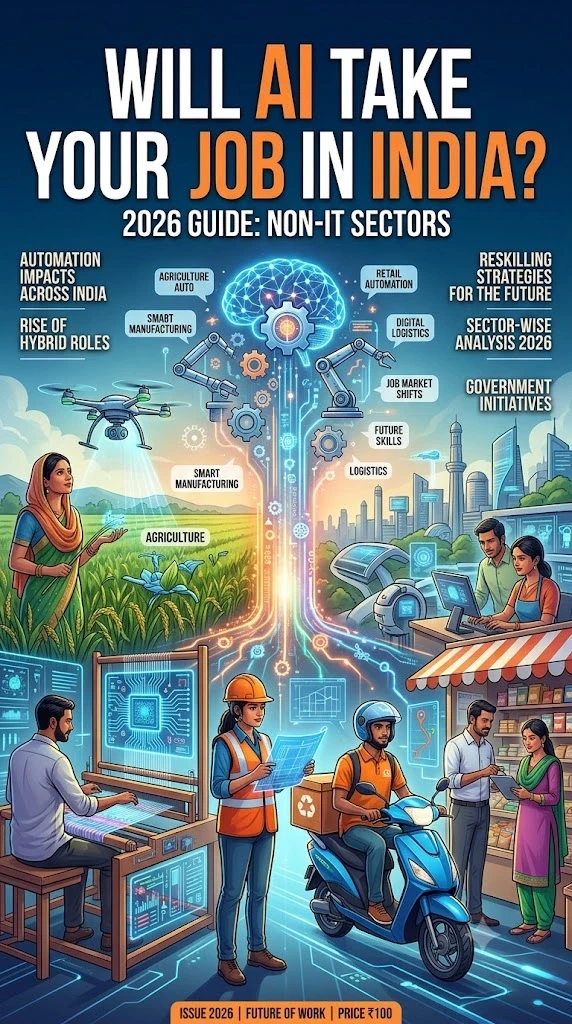
Will AI Take Away Your Job in Inda? The Real Picture for Non-IT & Entry-Level Careers (2026)
Almost everything written about "AI taking jobs" is aimed at software engineers and content writers. If you're a telecaller, in field sales, working in delivery, or doing data entry, most of that advice doesn't actually apply to you — and the headlines don't tell you what's genuinely changing in your line of work. This post does, using real research from 2026 rather than the panic-driven version that circulates on social media.
The Number That Actually Matters for India
Here's a fact that rarely makes it into the scary headlines: the World Bank's 2026 World Development Report found that only about 4.5% of jobs in lower- and middle-income countries like India are currently susceptible to generative AI automation, compared to 14.2% in high-income economies. India's overall job market is far less exposed than the US or Western Europe headlines suggest — but that average hides a very uneven picture underneath it, and understanding where you personally sit matters more than the national number.
The clearest example: India's IT services sector, which for decades absorbed hundreds of thousands of fresh graduates a year into entry-level coding and testing roles, is seeing a real contraction — estimates put it around a 20-25% reduction in traditional entry-level hiring as routine coding and testing work gets automated. That's a genuine, sector-specific shock. But it's concentrated almost entirely in IT services and white-collar office roles — not in the categories most job seekers on Workrr are searching for.
What's Actually at Risk (Be Honest With Yourself About This)
If your role is mostly repetitive and script-based, it's fair to expect real pressure over the next 1-2 years. Research from Salesforce found that AI is expected to resolve about half of all customer service cases by 2027, up from roughly 30% in 2025 — and that shift is concentrated specifically in FAQ answering, order-status checks, and standard policy questions. If your telecalling or support job is almost entirely "read from a script, check a status, repeat," that's the part AI systems are getting good at fastest.
The same applies to basic data entry and simple content-writing tasks — anything where the entire job is transcribing or reformatting information that already exists somewhere else.
This doesn't mean these job categories are disappearing. It means the boring, repetitive slice of them is shrinking, while the parts requiring judgment, negotiation, and trust are becoming relatively more valuable.
What's Genuinely Harder for AI to Touch
Physical-world work and trust-based work share something in common: AI can't do either one remotely. That's why these categories look structurally safer over the next several years:
- Delivery and field roles — someone still has to physically move a package or be present at a location. This isn't going anywhere until autonomous delivery becomes cheap and common at scale, which is still years away for most of India.
- Security and housekeeping — physical presence and human judgment in unpredictable, real-world situations are the entire job. Automation here is slow and expensive compared to the labor cost it would replace.
- Consultative field sales and merchant acquisition — convincing a shop owner to trust a new payment system involves reading a person, handling objections in real time, and building rapport. This is precisely the kind of negotiation-heavy, relationship-based work that stays valuable even as scripted phone support gets automated.
- Complex complaint resolution and retention calls — the escalated, emotionally-loaded calls that a script can't handle are, if anything, becoming more valuable as the simple calls get automated away, because someone still has to handle the customer AI couldn't satisfy.
How to Actually Position Yourself, Category by Category
If you're in telecalling or phone support: the way to stay ahead isn't fighting the automation of FAQ calls — it's actively moving toward the escalated, complex, or sales-oriented calls that require judgment. If your current role is purely script-reading, start asking your employer about moving into retention, upselling, or complaint-resolution queues, which are structurally more AI-resistant.
If you're in field sales or merchant acquisition: you're already in one of the more AI-resistant categories. The move here is leaning further into consultative skills — objection handling, building repeat relationships with merchants, understanding their business well enough to solve real problems, not just pitch a product.
If you're in delivery, security, or housekeeping: your job security comes from being reliable and physically present, which AI doesn't threaten directly. Where it's worth paying attention is basic app and technology comfort — companies in these categories increasingly manage scheduling, attendance, and performance through apps, and being comfortable with that layer keeps you competitive for supervisor and team lead promotions.
If you're in data entry: this is the category worth the most caution. The safest move is treating it as a stepping stone rather than a destination — use it to build basic computer and software fluency, then move toward roles that combine data work with judgment, like billing, coordination, or basic operations support, which are harder to fully automate.
The Nuance Nobody Mentions: AI Isn't Removing Work, It's Redistributing It
Data from South Korea offers a useful, less-discussed data point: between 2022 and 2026, youth employment there fell by roughly 285,000, with 94% of that decline concentrated in AI-exposed sectors like IT and professional services. In the same period, employment among workers in their fifties actually rose by about 230,000 — in those same sectors. The pattern wasn't "AI eliminated jobs," it was AI shifting who gets hired: experienced workers who can supervise and verify AI output held onto value, while the entry-level pipeline into those same roles narrowed.
The practical takeaway: this isn't a reason to panic about work disappearing — it's a reason to think about which side of that judgment-and-verification line your role sits on, and move toward the side that stays valuable.
Browse Jobs by Category on Workrr
- Telecaller jobs & salary guide
- Field Sales / Merchant Acquisition jobs
- Delivery Executive jobs
- Security Guard jobs
- Browse all jobs by city
Frequently Asked Questions
Which jobs are safest from AI in India in 2026?
Roles requiring physical presence (delivery, security, housekeeping) and trust-based negotiation (field sales, merchant acquisition) are structurally harder for AI to replace than purely script-based phone support or basic data entry.
Is telecalling disappearing because of AI?
The purely scripted, FAQ-answering portion of telecalling is shrinking as AI handles more routine service cases. Complex, escalated, and sales-oriented calling work is becoming relatively more valuable, not less.
Should I learn AI skills even if I'm not in IT?
Basic comfort with the apps and tools your industry uses is increasingly expected, even in non-tech roles — but you don't need to become an AI specialist. Judgment, communication, and reliability remain the core value in most entry-level and frontline categories.
Is India's job market as badly affected by AI as the US?
No — World Bank estimates put India's overall automation exposure well below that of high-income economies, though specific sectors like IT services entry-level hiring are seeing real, concentrated contraction.