Understanding Gold Loan Interest Rate in India
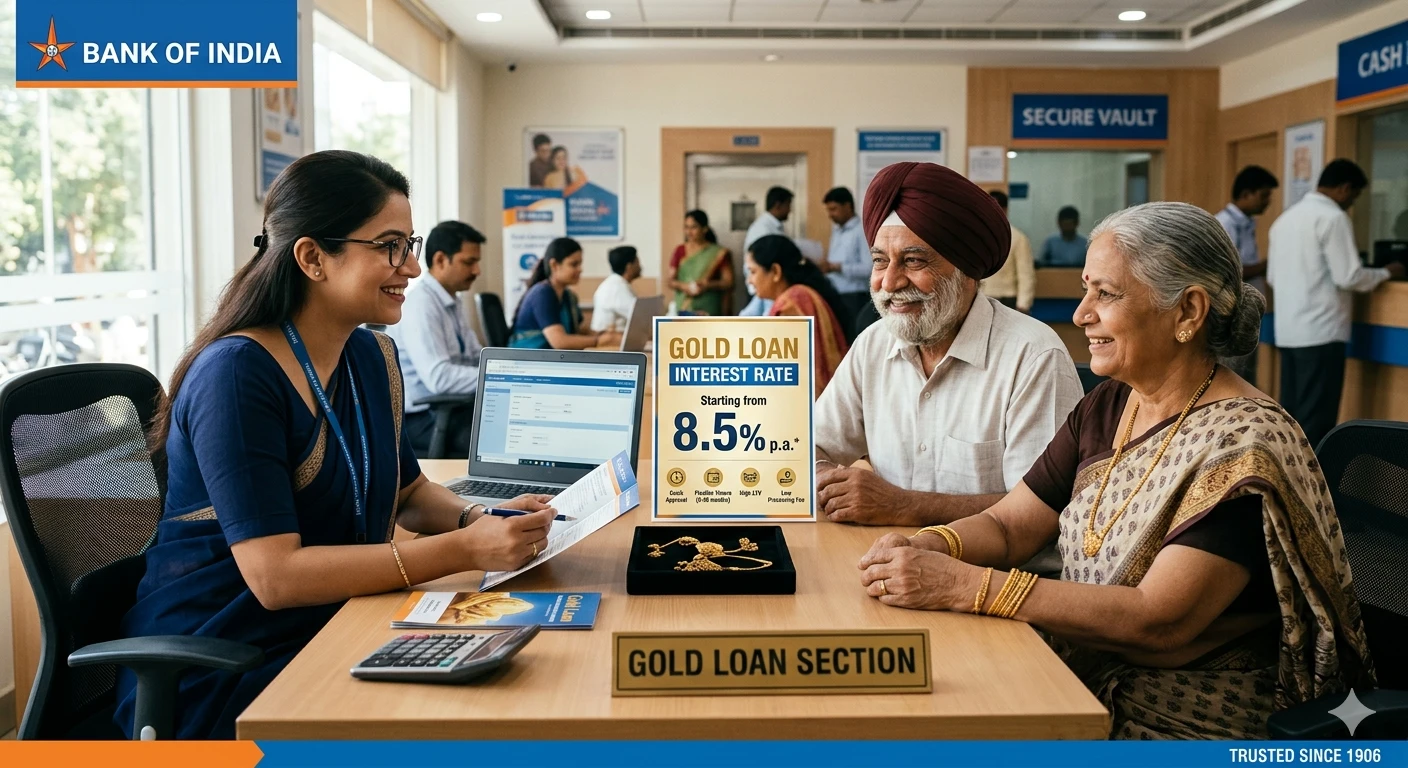
Exactly Is a Gold Loan?
A gold loan is a secured loan where you hand over your gold
jewelry or ornaments to a bank or NBFC as collateral, and they give you a lump
sum of cash in return usually within minutes.
Unlike a personal loan, there is no lengthy credit check.
The lender simply values your gold, offers you up to the RBI-mandated
Loan-to-Value (LTV) ratio, and you walk out with money. In 2026, the RBI
continues to cap the LTV at 75% for most lenders meaning if
your gold is worth ₹1,33,333, the maximum loan you can get is
₹1,00,000.
This simplicity is exactly why millions of Indians turn to
gold loans during emergencies, business crunches, or agricultural seasons. But
simplicity at the front counter can hide complexity in the repayment structure.
That complexity is what this guide unpacks.
75% Max LTV ratio RBI mandate, 2026~30
min Average disbursal Most NBFCs₹30 Cr+ Gold loan market
size India, 2025 estimate24% Max NBFC p.a. rate Typical ceiling,
2026
Understanding 2% Monthly Interest
Many NBFCs and private lenders advertise their gold loan
rate as "just 2% per month." That sounds small. It is not small.
A monthly rate of 2% translates directly to an annual rate
of 24%. In comparison, home loans in India currently sit around 8.5 9.5% per
annum. A gold loan at 2% per month costs you nearly three times as much as
a home loan on an annualised basis.
Annual rate formula
2% per month 12 months = 24% per
year
Simple interest annualisation
actual cost with compounding is even higher if you miss payments.
Public sector banks like the State Bank of India offer gold
loan rates starting at approximately 8.75% to 9.95% per annum,
which is roughly 0.73% to 0.83% per month dramatically cheaper. The catch is
that government banks have stricter documentation and slower processing. If you
need cash the same day, the NBFC route may be your
only option but you will pay for that speed.
💡 Quick sanity check
before you sign
Always ask your lender for the annual percentage
rate (APR), not just the monthly rate. Some lenders quote "1.5% per
month" but add processing fees, insurance charges, and stamp duty that
push the effective rate well above 24% annually.
₹1 Lakh Loan: The Complete Numbers
Let us run through a ₹1,00,000 gold loan at a 2%
monthly rate from start to finish, so there are no surprises when the first
bill arrives.
Your monthly interest payment
Monthly interest
₹1,00,000 0.02 = ₹2,000 per
month
This only covers interest. Your ₹1 lakh principal is
still fully owed until you repay it.
What you owe over one year
₹2,000 Each month Interest only
₹24,000 Per year Total interest cost
₹1,24,000 Bullet total Principal + 1yr
interest
These numbers assume simple interest and that you pay your ₹2,000 every month on time. If
you miss even one payment, the math changes significantly which we cover in
the next section.
How the EMI version differs
If you choose an EMI repayment option that covers both
principal and interest, your monthly payment will be higher than ₹2,000
but your total interest paid over the tenure will be lower because
you are reducing the principal balance each month. For a ₹1 lakh loan at
24% annual rate over 12 months, the approximate EMI is around ₹9,449
per month and your total interest paid drops to around ₹13,400
instead of ₹24,000.
Banks vs NBFCs: Which Lender Suits You?
The right lender depends on your priority: speed and
convenience, or lower cost. Here is a side-by-side comparison of key players in
2026.
State Bank of India
Public Sector Bank
8.75% 9.95% p.a.
Lowest rates. Requires documentation. Slower processing (1 2
days).
Indian Overseas Bank
Public Sector Bank
9.00% 11.5% p.a.
Competitive rates. Penal interest applies on overdue
amounts.
Manappuram Finance
NBFC
Up to 24% p.a.
Fast disbursal, flexible tenure. Online calculator
available. Penal charges apply.
Muthoot Finance
NBFC
Up to 24% p.a.
Pan-India network. Very fast processing. Multiple repayment
modes.
|
Feature |
Public Sector Banks |
NBFCs |
|
Interest rate (p.a.) |
8.75% 12% |
18% 24% |
|
Processing speed |
1 2 business days |
Same day / 30 min |
|
Documentation needed |
KYC + income proof |
KYC only |
|
Loan tenure |
Up to 3 years |
3 months 2 years |
|
Penal interest |
Varies (~2% extra) |
2 3% extra on overdue |
|
Auction risk threshold |
RBI-mandated LTV |
RBI-mandated LTV |
|
Best for |
Cost-conscious, time-flexible borrowers |
Emergency funds, self-employed |
Comparing gold loan features across lender types, June
2026
What Actually Happens When You Miss a Payment
Missing a single monthly interest payment on a gold loan is
not a minor inconvenience. It triggers a cascading financial penalty that can
snowball faster than most borrowers expect.
⚠ Three things happen the
moment you miss a payment
Your outstanding balance grows. Your next interest bill is
calculated on a larger principal. And you may be hit with a separate penal
interest charge on top of your standard rate.
- 1
Compounding begins on your
unpaid interest
Instead of staying at ₹1,00,000, your principal
effectively becomes ₹1,02,000 (original loan + unpaid ₹2,000
interest). The next month's interest is now calculated on ₹1,02,000,
costing you ₹2,040 instead of ₹2,000. Each missed payment adds to
this snowball.
- 2
Penal interest is applied on the overdue amount
Lenders like Manappuram Finance
and Indian Overseas Bank charge an additional 2% penal
interest on top of your standard monthly rate for the overdue amount. If your
standard rate is 2% per month, you are now paying effectively 4% on the missed
instalment.
- 3
The auction risk becomes real
If accumulated unpaid balances push your total outstanding
loan above the RBI's 75% LTV cap relative to your gold's current market value
which can shift as gold prices move your lender has the legal right to
auction your gold to recover their money. They must give you notice, but they
are not obligated to wait indefinitely.
The practical lesson: treat your monthly gold loan interest
payment with the same priority as a rent or utility payment. It is not
optional.
The Compound Interest Trap: A Worked Example
To make the missed-payment risk concrete, here is what
happens to a ₹1,00,000 loan at 2% monthly when three consecutive payments
are missed.
|
Month |
Opening Balance |
2% Interest Due |
Payment Made |
Closing Balance |
|
Month 1 |
₹1,00,000 |
₹2,000 |
₹0 (missed) |
₹1,02,000 |
|
Month 2 |
₹1,02,000 |
₹2,040 |
₹0 (missed) |
₹1,04,040 |
|
Month 3 |
₹1,04,040 |
₹2,081 |
₹0 (missed) |
₹1,06,121 |
|
Month 4 |
₹1,06,121 |
₹2,122 |
Resumed |
₹1,06,121 + penal |
After three missed payments, your loan balance has grown
from ₹1,00,000 to over ₹1,06,121 before any
penal interest is added. You now owe roughly ₹6,121 more than you
originally borrowed, simply from compounding. Add the 2% penal charge on three
months of overdue interest, and the true cost is higher still.
The auction trigger to watch
If gold prices drop while your balance grows, your LTV ratio
can breach 75% quickly. At that point the lender is within their rights to
proceed with auctioning your jewellery. Set a payment
reminder missing gold loan interest is never worth the risk of losing a
family heirloom.
The 3 Repayment Strategies: Which Costs You Least?
Your repayment structure has a direct impact on your total
interest bill. Here is a side-by-side breakdown of the three most common
options for a ₹1 lakh loan at 24% p.a. over 12 months.
Option A
Monthly Interest Only
You pay ₹2,000 every month to cover the interest. At
the end of the tenure, you repay the full ₹1,00,000 principal in one
shot.
Total interest paid: ₹24,000
Bullet Repayment
You pay nothing during the tenure. At the end, you pay
principal + all accumulated interest together. Only suitable if you have a
predictable large inflow ahead.
Total interest paid: ₹24,000+ (compounding risk if
extended)
Best Pick Option C
EMI (Principal + Interest)
A fixed monthly payment of approximately ₹9,449 that
covers both your principal repayment and interest. You are debt-free in 12
months with no lump-sum shock.
Total interest paid: ~₹13,400 saves ₹10,600 vs option A
How to choose the right strategy for you
The EMI option is the cheapest by total interest if you have
consistent monthly income. The monthly interest option works well if you are
expecting a single large payment (sale proceeds, bonus, harvest income) at the
end of your tenure. Avoid bullet repayment unless you are entirely certain of
your end-date cash flow unexpected tenure extensions quickly turn bullet
repayment into the most expensive option.
|
Strategy |
Monthly outflow |
Total interest (12M) |
Best for |
|
Monthly interest only |
₹2,000 + ₹1L at end |
₹24,000 |
Awaiting lump sum |
|
Bullet repayment |
₹0 during tenure |
₹24,000+ |
Short, certain tenures only |
|
EMI (principal + interest) |
~₹9,449 |
~₹13,400 |
Salaried / steady income |
Frequently Asked Questions
Can I get a gold loan without a PAN card in 2026?
Most lenders require a PAN card for loans above
₹50,000 as part of RBI's KYC compliance. For smaller amounts, an Aadhaar
card may suffice, but policies vary by lender. Always confirm before visiting
the branch.
Is gold jewellery safe when I
pledge it?
Licensed banks and registered NBFCs
are required to store pledged gold in secure vaults. However, you should
receive a written pledge receipt and request clarity on the insurance coverage
on your gold during the pledge period.
What gold purity is accepted for gold loans?
Most lenders accept gold ornaments of 18 to 24 carat purity.
Coins and bars are accepted by some lenders but rejected by others. Gold-plated
or gold-filled jewellery is typically not eligible.
Can I repay a gold loan early without a penalty?
Many lenders, especially NBFCs, now offer zero or minimal
prepayment charges on gold loans but this varies. Always confirm the
prepayment policy before signing the loan agreement, as some charge 1 2% of the
outstanding balance.
How long does a lender wait before auctioning my gold?
RBI guidelines require lenders to give you advance written
notice before auctioning pledged gold. The notice period and process vary by
lender, but in practice NBFCs typically initiate auction proceedings after 3 6
months of default. Check your loan agreement for the specific trigger
conditions.
Does taking a gold loan affect my credit score?
Yes. Gold loans are reported to credit bureaus. Timely
repayment can improve your CIBIL score. Missed payments and defaults will
negatively impact your credit history, which affects your ability to borrow in
the future.