Top 100 Azure Devops Interview Questions and Answers for 2026
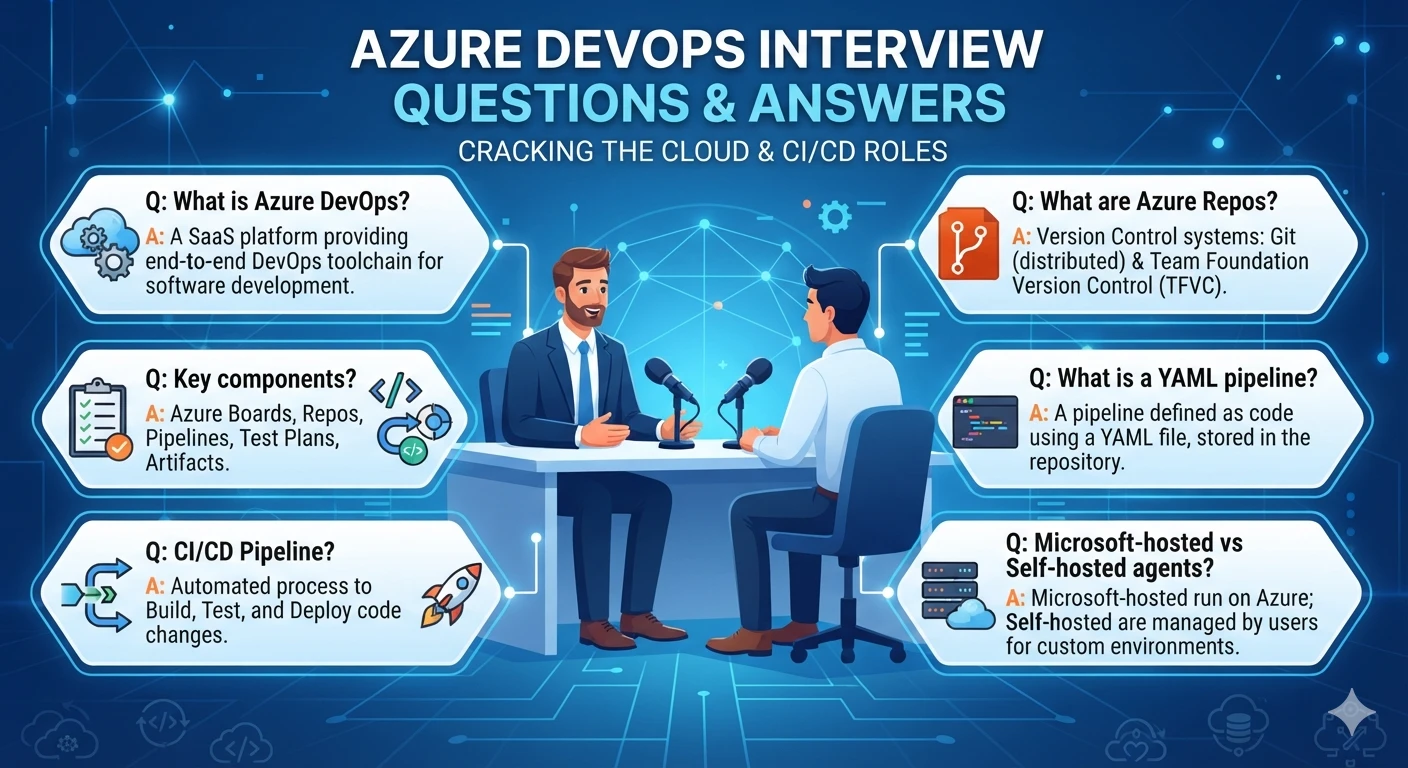
Below are 100 Azure DevOps Interview Questions & Answers (2026 Edition), organized from beginner to expert level. The questions reflect topics frequently covered in recent Azure DevOps interviews, including Azure Pipelines, Git, IaC, AKS, Docker, Terraform, security, monitoring, and scenario-based problem solving. Employers increasingly focus on practical experience rather than definitions alone.
Azure DevOps Interview Questions & Answers (2026)
Section 1: Azure DevOps Fundamentals (1-20)
1. What is Azure DevOps?
Azure DevOps is Microsoft's DevOps platform that helps teams plan, develop, test, deploy, and monitor applications.
Core Services
- Azure Boards
- Azure Repos
- Azure Pipelines
- Azure Test Plans
- Azure Artifacts
2. What are the main components of Azure DevOps?
- Boards – Agile planning
- Repos – Git repositories
- Pipelines – CI/CD
- Test Plans – Testing
- Artifacts – Package management
3. What is CI?
Continuous Integration automatically builds and tests code whenever developers commit changes.
4. What is CD?
Continuous Delivery ensures software is always ready for deployment.
Continuous Deployment automatically deploys every successful build into production.
5. Difference between CI, Continuous Delivery and Continuous Deployment?
| CI | Continuous Delivery | Continuous Deployment |
|---|---|---|
| Build & Test | Ready for Release | Auto Production Deployment |
6. What is Azure Pipeline?
A service that automates:
- Build
- Test
- Package
- Deploy
7. What is YAML Pipeline?
Pipeline defined as code using YAML.
Benefits:
- Version Controlled
- Reusable
- Easy Review
- Automation
8. Classic Pipeline vs YAML Pipeline?
Classic
- GUI
- Easy beginners
YAML
- Code based
- Version controlled
- Preferred in enterprises
9. What is Azure Board?
Work tracking system supporting:
- Epics
- Features
- User Stories
- Tasks
- Bugs
10. What is Azure Repos?
Git repository hosted by Microsoft.
11. What are Azure Artifacts?
Package repository supporting:
- NuGet
- npm
- Maven
- Python
- Universal Packages
12. What are Self-hosted Agents?
Build agents installed on your own VM.
Advantages
- Custom software
- Faster builds
- Private network access
13. Microsoft-hosted Agent?
Temporary VM provided by Microsoft.
14. What is Agent Pool?
Collection of build agents.
15. What is Build Pipeline?
Compiles source code into executable artifacts.
16. What is Release Pipeline?
Deploys application to environments.
17. What is Deployment Group?
Collection of target servers.
18. What is Variable Group?
Shared variables across pipelines.
19. Secret Variable?
Encrypted pipeline variable.
20. What is Service Connection?
Secure authentication between Azure DevOps and Azure resources.
Git & Repos (21-35)
21. Git vs TFVC?
Git is distributed.
TFVC is centralized.
22. Git Branching Strategies?
- GitFlow
- Trunk Based
- Feature Branch
- Release Branch
23. Merge vs Rebase?
Merge preserves history.
Rebase creates cleaner history.
24. Pull Request?
Code review before merge.
25. Why use Branch Policies?
Prevent bad code reaching main branch.
26. Git Cherry Pick?
Copies commit from one branch to another.
27. Git Reset vs Revert?
Reset changes history.
Revert creates opposite commit.
28. Git Fetch vs Pull?
Fetch downloads.
Pull downloads + merges.
29. Git Tags?
Marks release versions.
30. Git Hooks?
Scripts executed before/after Git events.
31. What is Squash Merge?
Multiple commits become one.
32. Protected Branch?
Cannot push directly.
33. Merge Conflict?
Occurs when same file modified differently.
34. How resolve merge conflicts?
Manual editing + commit.
35. Best Git Practices?
- Small commits
- Feature branches
- Pull Requests
- Code Review
Azure Pipelines (36-55)
36. Stages in Azure Pipeline?
- Build
- Test
- Package
- Deploy
37. Pipeline Triggers?
- Push
- Pull Request
- Schedule
- Manual
38. Multi-stage Pipeline?
Single YAML deploying across Dev → QA → UAT → Prod.
39. Pipeline Artifacts?
Files produced during build.
40. Cache in Pipeline?
Speeds builds.
41. Hosted vs Self-hosted Agents?
Hosted
Microsoft manages.
Self-hosted
Customer manages.
42. Deployment Strategies?
- Rolling
- Blue Green
- Canary
43. Environment Approval?
Manual approval before deployment.
44. Gates?
Validation before deployment.
45. Rollback?
Restore previous release.
46. Pipeline Templates?
Reusable YAML.
47. Runtime Parameters?
Input values while pipeline starts.
48. Conditions?
Run tasks only when condition is true.
49. Expressions?
Dynamic evaluation.
50. Matrix Strategy?
Run same build across multiple OS versions.
51. Parallel Jobs?
Multiple builds simultaneously.
52. Secure Files?
Certificates or keys stored securely.
53. Pipeline Variables?
Runtime configuration values.
54. Output Variables?
Variables shared between jobs.
55. Pipeline Failure Troubleshooting?
Check:
- Logs
- Agent
- Service Connection
- YAML
- Dependencies
Azure Services (56-70)
56. Resource Group?
Logical container.
57. Azure App Service?
PaaS hosting platform.
58. Azure Function?
Serverless compute.
59. Azure Storage Types?
- Blob
- Queue
- File
- Table
60. Azure Key Vault?
Secrets management.
61. Managed Identity?
Passwordless authentication.
62. Azure Container Registry?
Private Docker registry.
63. Azure Kubernetes Service?
Managed Kubernetes.
64. Virtual Machine Scale Set?
Auto scaling VMs.
65. Availability Set?
Improves VM availability.
66. Azure Load Balancer?
Layer 4 load balancing.
67. Azure Front Door?
Global Layer 7 load balancing.
68. Azure Monitor?
Monitoring platform.
69. Log Analytics?
Centralized log collection.
70. Application Insights?
Application performance monitoring.
Docker, Kubernetes & IaC (71-85)
71. Docker?
Container platform.
72. Image vs Container?
Image = Template
Container = Running instance
73. Dockerfile?
Instructions to build image.
74. Kubernetes?
Container orchestration.
75. Pod?
Smallest Kubernetes object.
76. Deployment?
Manages Pods.
77. Service?
Exposes Pods.
78. Ingress?
HTTP routing.
79. ConfigMap?
Stores configuration.
80. Secret?
Stores passwords securely.
81. Terraform?
Infrastructure as Code.
82. ARM Template?
Azure deployment JSON.
83. Bicep?
Simplified ARM language.
84. Terraform State?
Tracks infrastructure.
85. Terraform Workspace?
Separate environments.
Security & Monitoring (86-92)
86. DevSecOps?
Integrating security into CI/CD.
87. SAST vs DAST?
SAST
Static code analysis.
DAST
Runtime security testing.
88. Dependency Scanning?
Detect vulnerable packages.
89. Least Privilege?
Minimum required permissions.
90. Azure RBAC?
Role-Based Access Control.
91. Pipeline Secret Management?
Azure Key Vault.
92. Monitoring Metrics?
- CPU
- Memory
- Response Time
- Availability
- Error Rate
Scenario-Based Questions (93-100)
93. Build suddenly takes 40 minutes instead of 10. What would you do?
- Check logs
- Enable caching
- Optimize dependencies
- Use parallel jobs
- Upgrade agents
94. Production deployment failed. What next?
- Stop deployment
- Roll back
- Analyze logs
- Fix issue
- Redeploy
95. How would you deploy to multiple environments?
Dev → QA → UAT → Production
Use multi-stage YAML with approvals.
96. How secure secrets?
- Azure Key Vault
- Managed Identity
- Secret Variables
97. How would you design enterprise CI/CD?
- Git PR validation
- Unit Tests
- SonarQube
- Security Scan
- Docker Build
- Push ACR
- Deploy AKS
- Monitoring
98. Difference between Azure DevOps and GitHub Actions?
Azure DevOps provides a broader enterprise platform with Boards, Repos, Pipelines, Artifacts, and Test Plans, while GitHub Actions is tightly integrated with GitHub repositories and event-driven workflows. Many organizations use both together depending on their development ecosystem.
99. Which Azure DevOps features are most commonly used in enterprises?
- Azure Repos
- Azure Pipelines
- Azure Boards
- Azure Key Vault Integration
- Multi-stage YAML Pipelines
- Environment Approvals
- Service Connections
- Azure Monitor
- Terraform/Bicep Integration
100. What skills should an Azure DevOps Engineer have in 2026?
- Azure Cloud
- Git
- Azure Pipelines
- YAML
- Docker
- Kubernetes (AKS)
- Terraform or Bicep
- PowerShell/Bash
- Linux Administration
- Networking
- Azure Key Vault
- Azure Monitor
- CI/CD Best Practices
- DevSecOps
- Agile & Scrum
Most Frequently Asked Interview Topics in 2026
Based on recent interview guides and community discussions, interviewers emphasize practical, scenario-based questions over memorized definitions. The highest-priority areas include:
- Azure Pipelines (YAML)
- Git & Branching Strategies
- CI/CD
- Docker
- Kubernetes (AKS)
- Terraform/Bicep
- Azure App Service
- Azure Key Vault
- Azure Monitor
- Troubleshooting Pipeline Failures
- Security & DevSecOps
- Multi-stage Deployments
- Azure Networking Basics
- Infrastructure as Code
- Real-world Scenario Questions
If you're preparing for 5–10 years of experience, I can also provide a 300+ advanced Azure DevOps interview questions and answers PDF covering architecture, enterprise CI/CD, AKS, Terraform, Bicep, Azure networking, security, and real production troubleshooting scenarios.