Microsoft Layoffs 2026 | What 60,000 Employees Are Being Do
Microsoft Layoff What 60,000 Employees will deside
Can a company shrink its workforce without announcing a mass layoff? Microsoft is making that question hard to ignore.
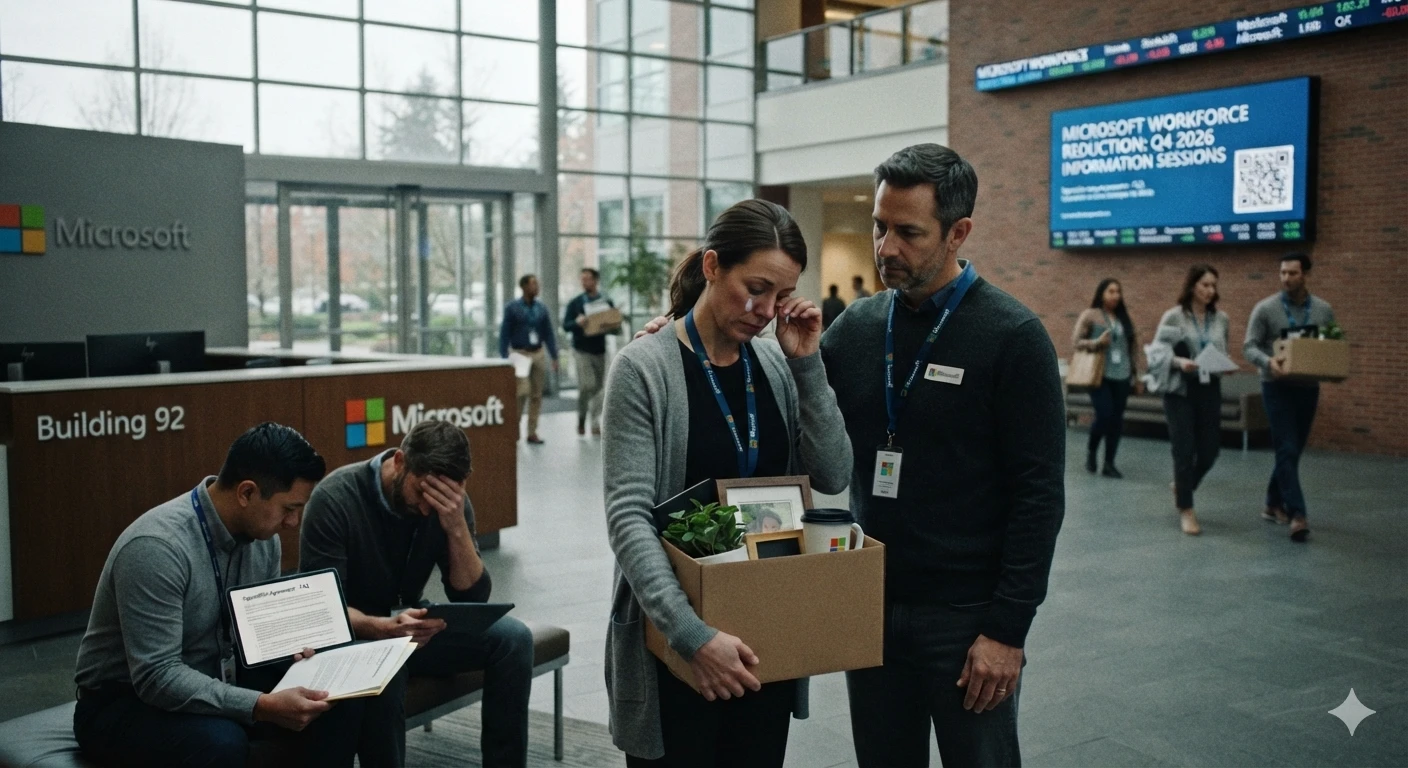
On October 26, 2026, the company announced a Voluntary Exit Offer (VEO) that could make roughly 60,000 employees eligible to leave with financial support. The key word is eligible. Nobody knows yet how many people will actually take the offer, and Microsoft hasn’t said it expects everyone to.
This follows earlier job cuts this year, while Microsoft keeps pouring money into AI infrastructure and reshuffling parts of its business. If you work in tech in India, this matters beyond one company’s headcount. It’s about how stable your career really is, which skills will count, and what the AI economy does to your job.
Here’s what “soft layoff” means, what’s confirmed, and what you can take from it.
So, what is a soft layoff?
It’s an informal label, not a legal one. It describes cutting headcount without the usual “you’re laid off, pack your desk” approach. A company might offer voluntary exit packages, freeze hiring, nudge people toward retirement, reorganise teams, or just let attrition do the work.
The goal is usually to cut costs, flatten management, or move money into areas expected to grow.
Is it really voluntary? Sometimes less than it sounds. If people feel their future at the company looks shaky, “voluntary” can feel like a polite word for “pressure.” But a voluntary exit programme isn’t proof that everyone who says no will be pushed out later. Those are two different things.
The practical difference from a traditional layoff is who makes the first move. In a traditional layoff, the company eliminates your role. In a soft layoff, you’re handed a choice, often with a deadline, and what happens next depends on the company’s plans and your own.
What Microsoft has actually announced
Amy Coleman, Microsoft’s executive vice president and chief people officer, confirmed the offer. Here’s what’s known:
- Who could be eligible: about 60,000 people, roughly 27% of the global workforce.
- Baseline headcount: around 223,000 full-time employees as of June 30, 2026.
- Countries: the US, Canada, the UK and India.
- Seniority: employees at internal level 70 and below in participating organisations.
- Areas mentioned in reporting: Copilot, AI experiences, Windows and Devices, Xbox, finance and HR, subject to eligibility rules and exclusions.
- Stated purpose: to give eligible employees a supported way out while Microsoft adjusts to changing business needs.
Again, these numbers show how far the offer could reach. They aren’t a count of jobs already gone. If you’re an employee, trust your own offer documents and official internal communication over rumours and guesses about package terms.
Why is Microsoft doing this?
There’s no single official explanation that covers every decision, but a few things clearly shape the picture.
AI is eating the budget. Data centres, computing capacity and the systems behind AI services are expensive. That investment opens new product opportunities, but it also pushes the company to ask how many people, with which skills, it needs in each business. That doesn’t mean AI is directly replacing the people affected. It means spending priorities are shifting.
Restructuring trims overlap. Big companies pile up management layers and teams working on similar problems. Reorganising can merge that work and sometimes remove positions even though the work continues. Microsoft described its July 2026 changes as aligning people and investment with business priorities, and said it had moved more than 4,000 employees into new roles over the previous year. So this isn’t one uniform process. It’s a mix of redeployment, voluntary exits and involuntary cuts.
Voluntary exits are gentler for everyone, at least on paper. For the company, they’re less disruptive than terminating positions outright. For an employee who was already thinking about leaving, a package can be a bridge to a new job, consulting, a startup or retirement.
Headcount is shrinking anyway. Microsoft had about 223,000 employees in June 2026, down from about 228,000 a year earlier. With job reductions announced in July and more restructuring in September, the company is clearly reshaping its workforce. That still doesn’t mean everyone who declines the offer will be laid off.
Is this really AI replacing jobs?
AI is part of the backdrop, but the evidence doesn’t support blaming it for every affected role. People tend to lump three different things together:
- Task automation: AI speeds up or takes over parts of a job.
- Role redesign: responsibilities get combined, teams get restructured, and people are expected to use AI as part of their normal work.
- Position elimination: a role disappears because of restructuring, weaker demand, overlapping work, cost-cutting, or some mix of these.
They can happen together, but they aren’t the same. An engineer who uses AI coding tools might get more productive and keep their job. Their team might still shrink after the company changes how it operates. Someone else might be affected simply because their product unit is being reorganised.
So the takeaway isn’t that AI makes every tech career unsafe. It’s that you should understand how your work ties into business results, and whether your skills match where the company is heading.
What this means if you work in India
India is on the list of covered countries, but that doesn’t mean every Microsoft employee in India is eligible. The offer applies to qualifying people in participating teams, under internal criteria. Microsoft hasn’t published how many eligible employees are in India or a full list of affected roles.
How you should respond depends on what you do:
Developers and engineers. Be the person who can design, test, secure and maintain production systems, not just generate code. System design, cloud architecture, AI-assisted development, automated testing, observability and secure engineering all help.
Cloud and infrastructure people. If you know Azure or another cloud, build on it with infrastructure as code, cost optimisation, platform and reliability engineering, and AI infrastructure. Companies still need people who can run complex systems, handle incidents and make good architectural calls.
IT support and operations. Move beyond repetitive ticket handling. Automation, scripting, root-cause analysis, identity and access management and cloud operations all push you toward work that needs judgement and ownership.
HR, finance and business operations. AI-enabled workflows will change routine reporting, admin and document processing. Process improvement, data analysis, governance, automation and stakeholder management are where you can grow.
For all of these, the idea is the same. Work out what will matter over the next two to three years, and build visible proof that you can do it.
How to gauge your own career risk
There’s no reliable public formula for predicting who gets hit by a future restructuring, and ordinary workplace changes aren’t proof a layoff is coming. A better move is to check how resilient your career is. Ask yourself:
- Does my work connect to a clear business priority? Know how your projects feed revenue, customer outcomes, security, reliability or key products.
- Can I show results with numbers? Fewer incidents, faster deployments, lower cloud costs, happier customers, more automation.
- Would my skills travel? Would they still be useful on another team, in another industry, on another platform?
- Am I getting better at AI and automation? Use the tools responsibly, know their limits, and check their output.
- Do I have a backup plan? An updated CV, a living network of contacts, and an emergency fund that fits your situation.
Good habits for any tech worker. They won’t tell you who Microsoft will choose in the future, and they aren’t meant to.
Should you take the package?
There’s no universal answer. It can be a great deal for one person and a bad one for another. Before deciding, look at:
- What you’d really get: the payment after taxes and deductions.
- Benefits and insurance: when they end and what continuation options exist.
- Your next step: realistic job prospects, likely salary, and how long a search could take.
- The fine print: the separation agreement, confidentiality terms, release of claims and any restrictions.
- Equity and incentives: what happens to unvested stock, bonuses and deferred pay.
- Your life: financial obligations, dependants, location, immigration status if it applies, and whether you’re ready to change careers.
Don’t say yes or no just because your colleagues are. Get the official terms, put your questions to HR in writing, and talk to a qualified legal or tax adviser if you need one.
What job seekers can learn from this
A famous employer name doesn’t mean permanent job security. That’s true across the tech industry, not just at Microsoft. Whether you’re eyeing IT services, product companies, startups or multinationals, three things help:
Show skills, not just certificates. A cloud certification means more when it comes with projects, automation scripts, architecture decisions or real troubleshooting experience.
Learn to work with AI. Know where it saves time, how to check what it produces, and how to keep confidential information safe.
Build a career that can travel. Cloud operations, cybersecurity, data engineering, software architecture, reliability and business-focused automation are useful at many employers.
When you size up a potential employer, look at how diversified the business is, how healthy the product or service you’d support is, what you’d learn, what it pays, and how stable the team looks. No skill guarantees a job, but transferable ones give you more options when a company changes direction.
Will more compulsory cuts follow?
It’s too early to say from this offer alone. A voluntary programme can reduce or reshape a workforce without terminating as many positions. How things play out depends on how many people accept, what the business needs, and what management decides.
Microsoft has already announced separate job reductions this year, so it would be wrong to say its changes are only voluntary. It would be just as wrong to claim that everyone who declines will be laid off. Stick to official announcements, your own offer documents and credible reporting, not social media speculation.
The bottom line
Microsoft’s voluntary exit programme shows that workforce change comes in several forms: voluntary exits, redeployment, restructuring and direct cuts. The offer’s reach is big, but eligibility isn’t the same as departure, and the programme alone doesn’t prove AI is replacing all these jobs.
For tech professionals in India and elsewhere, the sensible response is to stay informed, build skills that travel, understand the value of your work, and make big decisions based on verified facts.
The real lesson isn’t that every tech job is disappearing. It’s that career security now depends on how well you adapt when companies change their products, priorities and ways of working. The better question isn’t “Will AI take my job?” but “Will my skills and the value I bring still matter as the work changes?”