AI Job Disruption Is Already Reshaping the Global Workforce
The New Reality of AI Employment Disruption
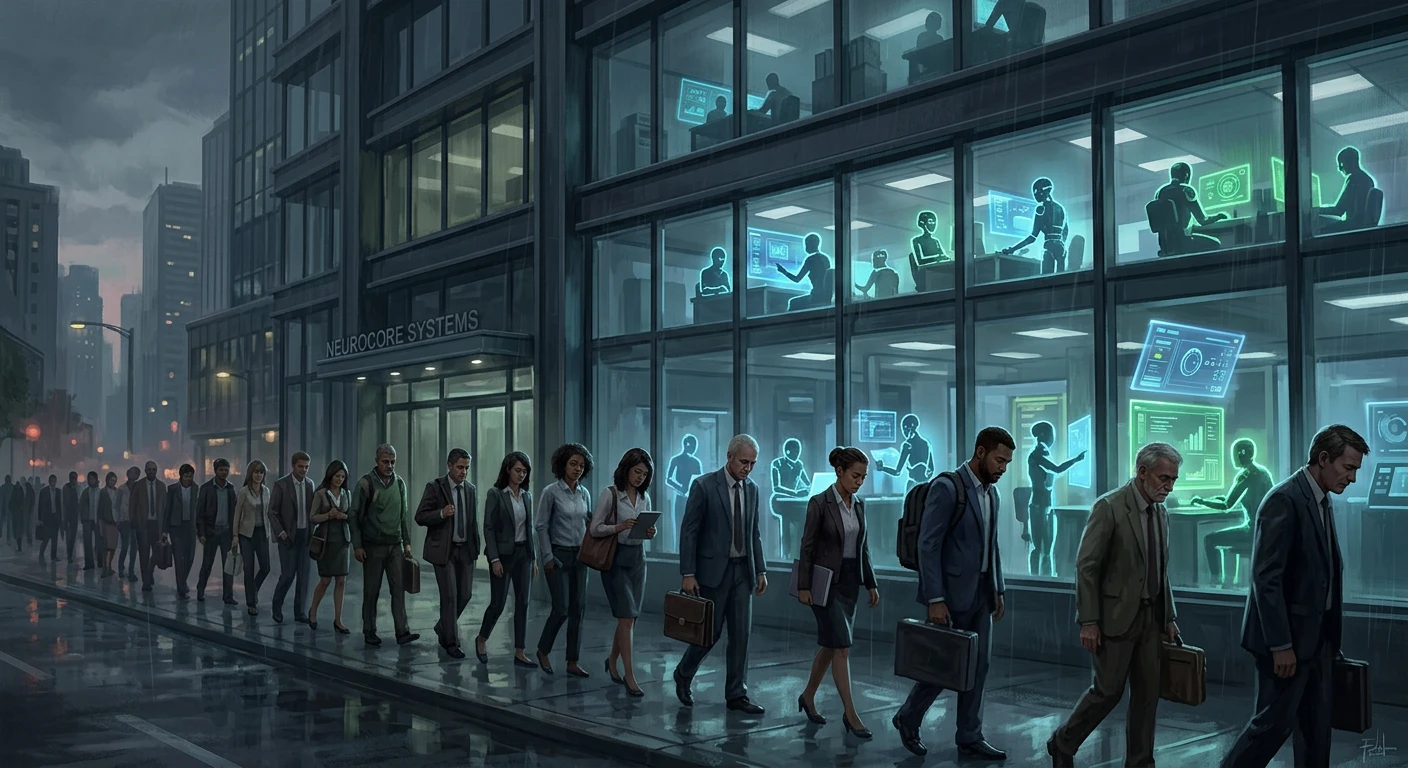
This isn't a future problem anymore. The conversation about AI replacing jobs has been going on for years, but somewhere along the way, the future quietly became the present. Hiring patterns are shifting. Entire departments are being restructured. And companies that once measured growth in headcount are now measuring it in compute budgets.
The change is visible in places that, five years ago, nobody expected it to be. Yes, it's in software. But it's also in marketing agencies, law firms, insurance companies, and customer support centers. The earlier wave of automation came for factory floors and assembly lines. This one is coming for the office.
What's driving it is simple economics. Generative AI, machine learning platforms, and intelligent automation tools can now handle cognitive tasks — drafting, summarizing, analyzing, classifying — that previously required a human being sitting at a desk for eight hours a day. Companies have noticed. Budgets that once funded new hires are increasingly going toward AI infrastructure instead.
Technology Was Just the First Domino
The tech industry felt it first. That's not surprising — these are the companies closest to the tools. But what happened inside the industry itself caught a lot of people off guard.
Junior software engineering roles started drying up. Not because software development itself slowed down, but because AI-assisted coding environments made smaller teams dramatically more productive. Why hire five junior engineers when two experienced ones with the right AI tools can outperform the whole group?
The talent that employers started chasing looked different. They wanted people who could manage AI workflows, review automated outputs, and catch the things the model got wrong. New job titles emerged — AI systems engineers, prompt engineers, ML operations specialists, AI governance roles. Some of these didn't exist three years ago. They're now among the hottest positions in the labor market.
The Quiet Collapse of Administrative Work
Administrative and clerical jobs don't make headlines the way tech layoffs do, but the structural change happening there may be even more significant. Back-office teams that once spent entire days processing invoices, drafting communications, scheduling meetings, and generating reports are being reduced — not because of any single dramatic announcement, but because AI tools now handle most of that work automatically.
What's left for human workers in those roles is increasingly the exception: the edge case, the judgment call, the situation the AI flagged as too ambiguous to handle alone. That's meaningful work, but it doesn't take a team of twenty to do it.
The hiring data is starting to reflect this. Growth in traditional clerical positions is flattening, while demand rises for people who can supervise automated systems and validate what they produce. The divide between workers who can collaborate effectively with AI and those who can't is widening, and it's widening fast.
Customer Service: The Most Visible Casualty
If you want to see AI disruption in real time, look at customer service. Intelligent conversational systems now field millions of inquiries every day across banking, retail, healthcare, telecom, and travel. They process refunds, troubleshoot problems, answer account questions, and route complex cases to the right human agent. They do it instantly, at scale, and at a fraction of the cost.
This doesn't mean human agents are disappearing entirely. What it does mean is that the work left for humans has changed. The interactions that still require a person tend to involve genuine complexity, emotional sensitivity, or relationship nuance — the kind of conversation where tone matters as much as content. Entry-level call center work, though, the kind that involves reading from a script and resolving straightforward tickets, is under serious structural pressure. The economics just don't favor it anymore.
The Middle Gets Hollowed Out
Labor economists have a name for what's happening to the workforce: polarization. The jobs facing the steepest risk aren't at the top or the bottom of the skill spectrum — they're in the middle.
Bookkeeping, basic accounting, data processing, paralegal research, insurance claims analysis, transcription, standardized reporting. These are all fields where AI systems genuinely excel, because they involve pattern recognition, classification, and procedural logic. A well-trained model can do this work faster and more consistently than most humans.
Meanwhile, two categories remain relatively resilient. At the high end, roles requiring complex strategic judgment, creative vision, or specialized expertise — AI architects, medical specialists, senior legal advisors — aren't going anywhere soon. At the other end, trades involving physical adaptability and unpredictable environments — electricians, plumbers, caregivers, mechanics — are also harder to automate than most people assumed. You can't send a robot to troubleshoot a faulty circuit in a hundred-year-old building.
The vulnerable middle is large. And it's where most of the workforce currently sits.
Fewer People, More Output
One of the more counterintuitive things happening right now is that companies are growing their revenue without growing their teams. AI-enhanced productivity means smaller groups can produce what once required significantly more people.
A marketing team of eight, armed with the right AI tools, can generate content, run analytics, optimize campaigns, and produce creative assets at a pace that would have required a team three times that size a few years ago. Legal firms are using AI for document review and contract analysis. Financial institutions are running fraud detection and risk modeling through AI systems. Healthcare networks are deploying AI for diagnostics and medical transcription.
The result is a fundamental reassessment of what a workforce should look like. Companies aren't hiring less because business is slow. They're hiring less because the math has changed.
Creative Work Is Not the Safe Harbor It Seemed
For a long time, the implicit assumption was that creative jobs were safe — that the things requiring imagination, taste, and originality were beyond what AI could do. That assumption hasn't aged well.
Generative AI can now produce articles, ad copy, images, video, music, and product designs. The quality isn't always exceptional, but it's often good enough, and it's fast and cheap. Businesses that once paid creative professionals to produce these things from scratch are increasingly asking those same professionals to oversee AI-generated drafts instead.
This doesn't eliminate creative work — it changes its nature. The value moves upstream, toward direction, strategy, and the kind of originality that distinguishes a brand from its competitors. The professionals who are adapting are learning to use AI as a production tool while focusing their human energy on what the machine can't replicate: genuine aesthetic judgment, cultural intuition, and narrative coherence. Those who haven't adapted are finding the demand for purely manual creative production drying up.
The Economics Are Getting Uncomfortable
Beyond individual industries, the broader economic consequences of this shift are starting to come into focus — and some of them are genuinely difficult.
Hiring growth is slowing even at companies with strong revenues. Wage compression is emerging in sectors where AI has reduced the scarcity of certain skills. Global remote work, enabled partly by AI tools, has broadened the pool of competition for knowledge jobs across geographic boundaries. Skills that took years to develop are becoming obsolete faster than people can retrain. And the premium paid to workers who can manage AI systems, interpret data, and think strategically keeps climbing.
Long-term career stability, the kind where mastering a skill set at twenty-five meant security at fifty, is a much harder promise to make than it used to be.
Education Is Still Catching Up
Universities and professional schools are under real pressure right now, even if many haven't fully admitted it yet. Traditional degree programs were designed for a labor market that rewarded static qualification. The degree said: this person learned a defined body of knowledge and can apply it reliably.
That model doesn't fit a world where the tools change every eighteen months. Employers are increasingly looking for AI literacy, adaptability, critical thinking, and the ability to learn continuously — things that four-year programs, by their nature, struggle to develop. The institutions that figure out how to teach these things will produce graduates who can compete. The ones that don't will keep sending people into a market they weren't prepared for.
New Careers Are Actually Emerging
It's worth saying clearly: AI isn't just destroying jobs. It's creating them. The categories of work that didn't exist a decade ago and are now growing rapidly include AI governance specialists, machine learning engineers, data curators, AI security analysts, and human-AI interaction designers. These aren't niche roles — they're becoming foundational to how large organizations operate.
The labor market isn't simply shrinking. It's reorganizing around a different set of needs and capabilities. The challenge is that the timeline of reorganization is fast, and the people displaced by the old structure don't automatically fit the new one.
Why This Is Only Going to Accelerate
Large language models are improving quickly. The cost of deploying AI systems is falling. Cloud services are making advanced AI accessible to businesses that couldn't have afforded it three years ago. Venture capital continues pouring into AI startups. Competition between enterprises is creating pressure to automate or fall behind.
The pace of this transformation may end up being faster than any previous technological disruption, for one basic reason: software scales globally overnight. The Industrial Revolution reshaped labor markets over generations. AI could do it in a decade.
What Workers Can Actually Do
The people who will fare best in this environment probably aren't the ones who try to compete with AI at tasks AI is good at. They're the ones who learn to work alongside it — using AI tools to amplify their own output while building skills in the areas where human judgment still matters: complex reasoning, ethical oversight, creative direction, interpersonal communication, and strategic thinking.
None of that is comfortable or simple. It requires continuous learning and a willingness to update assumptions about what your career looks like. But the alternative — waiting for the disruption to pass, or hoping your current skill set will stay relevant on its own — is the higher-risk bet.
Conclusion
The data is no longer ambiguous. AI-driven disruption isn't a theory or a projection. It's an active force reshaping who gets hired, what they're paid, and what kind of work they're expected to do. Some of this is painful and some of it is genuinely exciting, often at the same time.
The deeper challenge isn't really about whether AI will replace jobs. It will replace some, transform others, and create new ones entirely. The harder question is whether workers, companies, educators, and governments can move fast enough to keep up with a transition that isn't waiting for anyone to get ready.